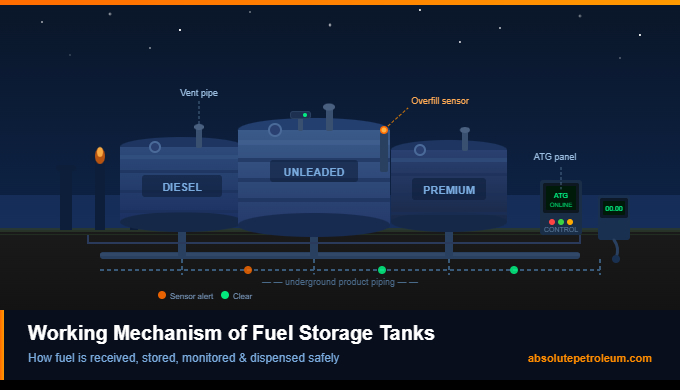
Fuel storage tanks store petroleum products using sealed, corrosion-resistant vessels made of steel or fiberglass. They include fill pipes, vent systems, submersible pumps, overfill protection devices, and leak detection systems that work together to safely receive, hold, and dispense fuel. Both aboveground storage tanks (ASTs) and underground storage tanks (USTs) follow strict regulatory requirements to prevent spills, leaks, and vapour release into the environment.
How Do Fuel Storage Tanks Actually Work?
Fuel storage tanks are everywhere. You’ll find them at gas stations, bulk fuel plants, remote industrial sites, and commercial properties. But most people never think about what happens below the surface.
These tanks are complex systems. They don’t just hold fuel. They control vapour, prevent overfills, detect leaks, and deliver fuel safely on demand.
In this guide, we break down the full working mechanism of fuel storage tanks — from the moment fuel enters to the moment it leaves.
1. The Two Main Types of Fuel Storage Tanks
Before understanding how they work, you need to know the two primary categories:
Aboveground Storage Tanks (ASTs)
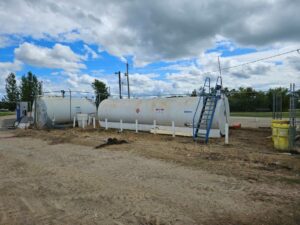
ASTs sit on the surface. They are easier to inspect and maintain. You can see them at bulk fuel plants and large commercial operations. They require secondary containment — a berm or containment pad to catch spills.
Underground Storage Tanks (USTs)
USTs are buried below ground. You’ll find them at most retail gas stations. They are hidden from view but require the most sophisticated monitoring systems. The EPA estimates a well-maintained UST can last 30 years or more.
Both types share the same core components. The location is what changes — not the fundamental working principle.
2. Tank Construction and Materials
A fuel storage tank must resist corrosion, pressure, and chemical degradation. The two most common materials are steel and fibreglass.
Steel tanks are durable and fire-resistant. They handle harsh weather well. But they can corrode without proper coating or cathodic protection.
Fibreglass tanks resist corrosion naturally. They are lighter and don’t rust. They are a popular choice for USTs in wet or corrosive soil conditions.
Modern tanks often use a double-wall design. The space between the two walls — called the interstitial space — is monitored continuously for leaks. If fuel appears in this gap, an alarm triggers immediately.
3. The Fill Process: How Fuel Gets Into the Tank
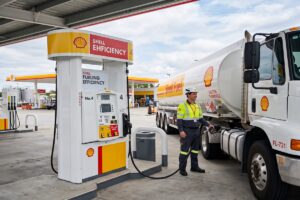
Fuel arrives by tanker truck. The driver connects a hose to the tank’s fill pipe. This pipe leads directly into the tank interior.
As fuel flows in, air and vapour must escape. This is where the vent pipe plays a critical role.
The vent pipe is equipped with a flame arrester. This device allows vapour out but prevents any external flame from igniting the fuel inside. It’s a simple but essential safety feature.
During filling, a spill bucket sits around the fill pipe at the surface. It catches any small spills that happen during hose connection or disconnection. The bucket must be kept clean and free of debris.
4. Overfill Protection: Stopping the Tank at the Right Level
One of the most critical mechanisms is overfill prevention. Tanks must never exceed safe capacity — typically 95% full.
There are three main overfill protection devices:
Overfill Prevention Valve (OPV)
This valve sits inside the fill pipe drop tube. As fuel rises, a float mechanism closes the valve automatically. It stops fuel flow before the tank reaches dangerous levels.
Ball Float Valve
This device restricts vapour flow through the vent when fuel reaches 90% capacity. It creates back-pressure that signals the delivery driver to stop filling. It requires monthly checks to ensure the ball moves freely.
Electronic Tank Alarm
An electronic sensor triggers an audible or visual alarm when fuel reaches 90% capacity. This is the most reliable and verifiable method. Modern systems connect to an Automatic Tank Gauge (ATG) for real-time monitoring.
5. How Fuel Is Stored Safely Inside the Tank
Once inside, fuel rests in a sealed environment. Temperature, pressure, and contamination are the biggest risks.
Fuel has a shelf life. Gasoline lasts roughly 6 months in optimal storage conditions. Diesel can last up to 12 months. After that, it degrades and can clog fuel system components.
Tanks are designed to minimise vapour loss. Fixed-roof tanks include pressure-vacuum (PV) vents. These open only when internal pressure or vacuum exceeds safe limits — allowing the tank to ‘breathe’ without releasing excessive vapour.
Floating roof tanks use a roof panel that sits directly on the fuel surface. As the fuel level drops, the roof drops with it. This eliminates the vapour space above the liquid and significantly reduces evaporation. This design is common in large petroleum industry storage.
Water contamination is a serious concern. Water sinks to the bottom of the tank. Sensors and water-finding paste help detect accumulated water during regular inspections. Water must be removed to prevent microbial growth and fuel degradation.
6. Leak Detection: Constant Monitoring Below Ground
Leak detection is a regulatory requirement for all USTs. There are several accepted methods:
Automatic Tank Gauging (ATG)
An ATG system uses sensors inside the tank to measure fuel level, water level, and temperature continuously. The system can detect small inventory discrepancies that may indicate a leak. Modern ATG systems monitor multiple tanks simultaneously.
Interstitial Monitoring
In double-wall tanks, sensors sit in the interstitial space. If any liquid enters this space — from either the inside or outside — an alarm fires. This is considered one of the most reliable leak detection methods.
Groundwater and Vapour Monitoring
Monitoring wells are installed near the tank. Vapour probes detect fuel that has leaked into the surrounding soil. Groundwater wells detect contamination in the water table. These methods provide an additional layer of environmental protection.
7. The Dispensing System: How Fuel Gets Out
When a customer or operator needs fuel, the dispensing system activates. Here’s how it works:
A submersible turbine pump (STP) sits inside the tank. It’s submerged in the fuel at the bottom. When a dispenser activates, the STP pushes fuel up through product piping to the dispenser above.
Piping runs underground from the tank to each dispenser. This piping is typically double-walled or placed in a containment jacket with its own leak detection.
At the dispenser, a shear valve protects against accidents. If a vehicle drives off with the nozzle still attached, the shear valve breaks at a designed weak point. It stops fuel flow and prevents a spill.
Emergency shut-off valves (also called crash valves or impact valves) provide additional protection. They close automatically if the dispenser is knocked over or damaged.
8. Corrosion Protection for Underground Steel Tanks
Steel USTs require active corrosion protection. Without it, the tank corrodes from the outside in — eventually causing leaks.
Cathodic protection is the standard solution. It works by applying a small electrical current to the tank. This current counteracts the electrochemical reaction that causes corrosion.
There are two types: sacrificial anode systems use a more reactive metal (like magnesium or zinc) that corrodes instead of the tank. Impressed current systems use an external power source to supply the protective current continuously.
Corrosion protection must be tested regularly. Failure leads to tank degradation and potential environmental liability.
9. Regulatory Compliance and Tank Maintenance
Fuel storage tanks operate under strict regulations. In Canada, provincial environmental agencies set the standards. Operators must maintain records of inspections, testing, and any equipment changes.
Key maintenance tasks include:
Regular inspection of spill buckets, fill caps, and vent pipes. Testing of overfill prevention devices. ATG system calibration and sensor checks. Annual tightness testing for older tanks. Cathodic protection testing every 3 years.
Tanks that are no longer compliant must be upgraded or decommissioned. A non-compliant tank is a regulatory and environmental liability.
10. Why Proper Installation Matters
A fuel storage system is only as reliable as its installation. Improperly installed tanks, pipes, or sensors can fail — even if the individual components are high quality.
Licensed petroleum technicians follow strict installation protocols. They ensure that every component — from the tank base to the vent cap — is correctly installed, sealed, and tested before the system goes live.
At Absolute Petroleum, our team of Licensed Petroleum Technicians (LPTs) brings over 200 combined years of experience to every installation. We work across Manitoba and Canada — from gas stations to bulk fuel plants to remote industrial sites.
Final Thoughts
Fuel storage tanks are sophisticated systems. Every component has a purpose. Every mechanism is there to protect people, property, and the environment.
Understanding how these systems work helps operators make better decisions — about maintenance, upgrades, and compliance.
Whether you’re planning a new bulk fuel plant, upgrading an existing UST, or dealing with an emergency repair, working with experienced petroleum contractors is essential.
Need expert help with your fuel storage system? Contact Absolute Petroleum today — Manitoba’s largest petroleum contractor.