Building a bulk fuel plant is not like constructing a standard commercial facility.
Every decision — tank placement, piping materials, electrical design — is governed by federal and provincial regulations, environmental codes, and safety standards that carry real enforcement consequences.
For community fuel operators, First Nations organizations, commercial distributors, and industrial operators across Canada, understanding what the construction process actually involves is the difference between a smooth project delivery and a costly, delayed one.
Here is what to expect — from the first site visit to the final inspection sign-off.
What Is a Bulk Fuel Plant?
A bulk fuel plant is a facility where petroleum products — gasoline, diesel, heating oil, or aviation fuel — are stored in large quantities and distributed to downstream users.
This is distinct from a retail fuel station. A bulk plant stores fuel for transfer to other facilities, vehicles, or distribution networks — not for direct sale at the pump.
In Canada, bulk plants range from large urban fuel terminals to remote community storage facilities serving fly-in First Nations communities with no road access.
The scale differs. The regulatory requirements do not.
The Regulatory Landscape
Before ground is broken, the regulatory framework needs to be clearly understood.
At the federal level, the Storage Tank Systems for Petroleum Products and Allied Petroleum Products Regulations — enacted under the Canadian Environmental Protection Act, 1999 (CEPA) — govern the design, construction, and operation of storage tank systems under federal jurisdiction.
At the provincial level, each province maintains its own petroleum storage regulations. In Manitoba, these fall under the Manitoba Environment Act. In Ontario, the Technical Standards and Safety Authority (TSSA) governs petroleum storage and requires contractors to hold active registration before performing any work on fuel equipment.
The Canadian Council of Ministers of the Environment (CCME) publishes the Environmental Code of Practice for Aboveground and Underground Storage Tank Systems — a benchmark document incorporated by reference in most provincial regulations.
Navigating these overlapping frameworks is one of the most underestimated challenges in bulk plant construction. A contractor experienced across multiple provinces is essential for any operator with facilities in more than one jurisdiction.
Stage 1: Site Assessment and Engineering Design
Every project starts with a thorough site assessment.
Geotechnical conditions — soil type, bearing capacity, groundwater depth — directly affect tank foundation design and secondary containment specifications. High water tables can shift a design from underground storage tanks (USTs) to aboveground storage tanks (ASTs).
Proximity to water courses, drainage systems, and property boundaries must be mapped against separation distances required under the CCME Code and provincial regulations.
The assessment also identifies the authority having jurisdiction (AHJ) — the provincial or municipal body that will review plans, issue permits, and conduct inspections.
The engineering design package that follows covers tank sizing, secondary containment design, piping layout, electrical area classification drawings, and fire suppression requirements. A complete, well-prepared package is what keeps the permit process moving. A poorly prepared one causes weeks of delays.
Stage 2: Tank Selection
The choice between aboveground storage tanks (ASTs) and underground storage tanks (USTs) is one of the most consequential decisions in bulk plant construction.
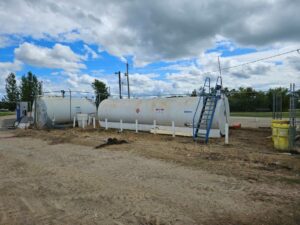
ASTs are easier to inspect, easier to maintain, and generally preferred by Canadian regulators from an environmental monitoring standpoint. Secondary containment (diking) is mandatory — sized to hold a minimum of 110% of the capacity of the largest tank in the contained area.
USTs reduce above-grade footprint and evaporative losses, but carry greater environmental risk if they leak. They require secondary containment piping, cathodic protection systems, and mandatory registration once capacity thresholds are reached.
Both tank types must be built to ULC-certified standards and carry the required certification marks on all components.
For a detailed comparison of both options, see: Aboveground vs Underground Storage Tanks: Which Is Right for Your Bulk Plant? (link to cluster article)
Stage 3: Civil Work, Tank Installation, and Piping
With permits issued and tank selection finalized, construction begins.
Civil work covers site grading, foundation preparation, and dike construction for AST installations, or excavation and engineered backfill for UST installations.
Tank installation requires crane work for ASTs and carefully controlled lowering and anchoring for USTs. All connections — fill lines, vent lines, delivery lines, and emergency shut-off connections — must be made using ULC-certified fittings and piping materials.
Underground piping must conform to CAN/ULC-S660 or CAN/ULC-S679. Secondary containment piping — a pipe-within-a-pipe system — is required to allow leak detection in the annular space between the primary and containment pipe.
All welded piping joints are performed by qualified welders with documented procedures. At Absolute Petroleum, electrical, piping, and welding work is delivered by the same integrated team — eliminating the coordination gaps that occur when multiple subcontractors share a scope.
Stage 4: Electrical Installation
The electrical scope at a bulk fuel plant is specialized and governed by the Canadian Electrical Code (CEC) Sections 18 and 20.
Bulk plant environments are classified hazardous areas. Flammable vapours are present around tank vents, fill connections, product transfer areas, and pump enclosures. Every electrical component installed in a classified zone must be rated for that environment.
Key electrical elements at a bulk plant include:
- Main service and distribution panel
- Pump motor circuits
- Hazardous-location-rated lighting
- Automatic tank gauge (ATG) system wiring
- Leak detection and interstitial monitoring connections
- Emergency shut-off (ESD) circuit wiring at all product transfer points
- Grounding and bonding of all metallic fuel system components
- Cardlock or fuel management system infrastructure
All conduit penetrations through hazardous zone boundaries must be sealed to prevent vapour migration.
For a full breakdown of petroleum electrical requirements, see our article on oil & gas electrical solutions.
Stage 5: Tank and Line Pressure Testing
Before any product enters the system, all tanks and piping must pass pressure testing.
Tank pressure testing verifies the structural integrity of the tank shell and all penetrations. Line pressure testing applies positive pressure to the piping system and monitors for pressure drop — any drop indicates a leak requiring repair before the test is repeated.
In Canada, test results, procedures, and sign-offs are formally documented and submitted to the authority having jurisdiction as part of the commissioning record.
Absolute Petroleum performs aboveground and underground fuel tank (AGFT/UGFT) and line pressure testing as a standard component of every new build and major system upgrade.
For a detailed look at how this process works, see: How Bulk Fuel Plant Pressure Testing Works in Canada (link to cluster article)
Stage 6: Commissioning and Final Inspection
Commissioning verifies that every system performs as designed before the facility enters service.
The commissioning sequence covers ATG calibration, leak detection functional testing, emergency shut-off verification, pump operation checks, electrical system sign-off, overfill protection device testing, and grounding continuity confirmation.
Final inspection is then conducted by the authority having jurisdiction. Inspectors review the full documentation package — engineering drawings, material certifications, pressure test records, electrical inspection certificates, and commissioning sign-offs — alongside an on-site verification.
A well-organized documentation package is the difference between a clean sign-off and a deficiency list that delays commissioning by weeks. Experienced contractors build this documentation throughout the project, not at the end.
Stage 7: Annual Inspections and Ongoing Compliance
Construction completion is not the end of the compliance journey.
Bulk fuel plants in Canada are subject to ongoing provincial and federal annual site inspections. These verify that leak detection systems are functioning, secondary containment is intact, overfill protection is operational, and environmental safeguards remain effective.
Facilities that fall out of compliance face orders to remediate within set timeframes. Repeated non-compliance can trigger facility shutdown and financial penalties under CEPA and provincial environmental legislation.
Absolute Petroleum supports bulk plant operators with ongoing maintenance and annual inspection readiness — keeping facilities operational, compliant, and audit-ready year over year.
Remote and First Nations Bulk Plant Construction
Remote community fuel infrastructure in Canada presents challenges that don’t exist at urban sites.
Many First Nations and remote communities across Manitoba and Northern Ontario are accessible only by air or seasonal winter road. Material logistics, crew deployment, compressed timelines, and extreme cold weather conditions add layers of complexity that separate contractors who have done this work from those who haven’t.
Absolute Petroleum has delivered bulk fuel plant construction at Red Sucker Lake, Split Lake First Nation, OCN First Nation, Jenpeg Hydro, Kasabonika, Wapekeka, Muskrat Dam, and Manitoba Narrows First Nation — communities where the margin for error is limited and the communities depending on the outcome have no alternative fuel supply.
For a detailed look at what remote bulk fuel construction actually involves, see: Building Bulk Fuel Infrastructure in Remote and First Nations Communities (link to cluster article)
Choosing the Right Bulk Fuel Plant Contractor
The contractor you select determines whether your project is delivered on time, on budget, and with a commissioning record that passes inspection.
Look for these qualifications:
LPT certification. Licensed Petroleum Technicians are the governing credential for petroleum systems work in Canada. Verify the entire team holds this — not just the company principal.
Multi-discipline capability. Civil, tank installation, piping, welding, and electrical scopes delivered by one team eliminates coordination risk and accountability gaps.
Regulatory knowledge. Your contractor must understand federal and provincial requirements in every jurisdiction where you operate.
Documentation discipline. Complete, organized project records built throughout construction — not assembled at the end.
Remote project experience. If access is constrained, ask for specific references from comparable projects in comparable conditions.
Safety certifications. COR certification and ISNetworld registration are the standard benchmarks required by engineering firms, government clients, and major fuel operators.
How Absolute Petroleum Delivers Bulk Fuel Plant Construction
Absolute Petroleum has been building, upgrading, and maintaining bulk fuel plants and gas stations across Canada for over 20 years.
The company self-performs the full construction scope — civil work, tank installation, AGFT/UGFT pressure testing, piping, welding, electrical, and commissioning. One team. One accountable contractor. No gaps between disciplines.
With 30+ professionals carrying over 200 years of combined Licensed Petroleum Technician experience, Absolute Petroleum is Manitoba’s largest petroleum contractor — with a track record spanning major urban centres and remote fly-in communities across Canada.
COR certified. ISNetworld compliant. Trusted by engineering firms, government clients, Indigenous organizations, and major fuel operators nationwide.
Planning a bulk fuel plant construction project or upgrading an existing facility?
Connect with Absolute Petroleum via our Contact Us Form or call 204-219-3723.